The case for an AI-Augmented Development methodology
Let’s examine what engineering teams, AI Champions and AI communities of practice need to explore, reflect on, and share. So they can apply new learnings across different teams and contexts, advance the craft, and scale AI-Augmented Development adoption.
Software development is undergoing another revolution, this time driven by AI used to generate code and to accelerate the entire SDLC. AI is rapidly changing how we build products and how teams work.
Until now, the conversation around AI in software engineering has been primarily dominated by:
- the announcements of new powerful models and powerful AI development tools,
- radical experiments with
- autonomous agents trying to create entire products without human supervision and code reviews (tokenmaxxing),
- approaches to product development trying to treat source code as a disposable byproduct of AI generation
The AI discourse driven by social media trends and vendor hype isn’t helping either.
Nonetheless, professionals and organisations with mature products and complex brownfield codebases are adopting AI into their SDLC, working to advance and reimagine their practices and ways of working.
This AI evolution is moving so fast that our shared terminology is struggling to keep up. This rapid state of flux makes it harder to establish:
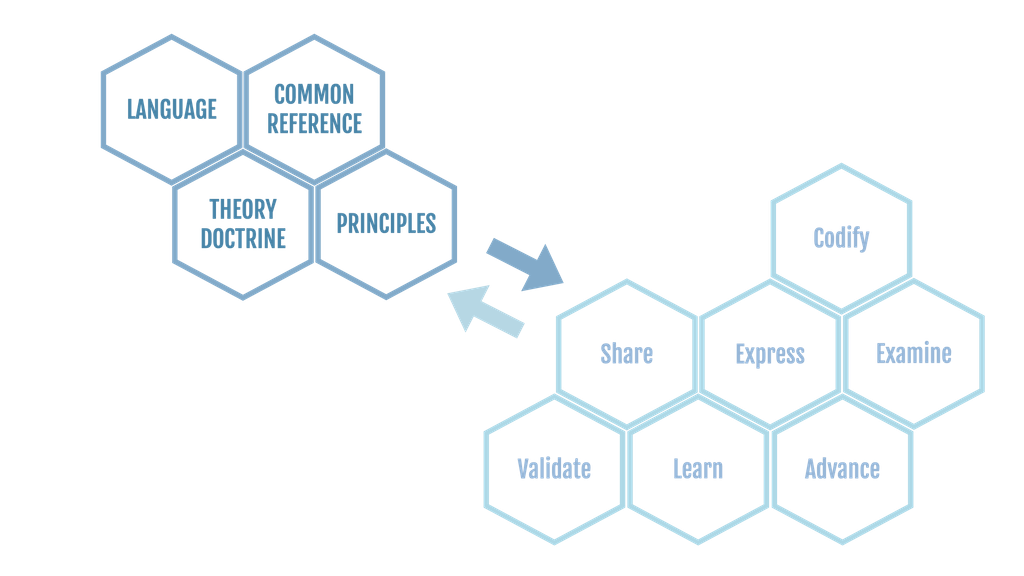
- A common reference: defining what “good” should look like in AI-Augmented Development
- A shared language: enabling us to talk about and share the learning and the experiments
- A doctrine: to think about, critically examine and rigorously evaluate new ideas, practices and techniques
- Core Principles: identifying which traditional software engineering principles still hold true in this AI age, which are now obsolete, and which new principles can guide us.
In short, we need an AI-Augmented Development methodology to enable us to:
codify and share new learning, express and evaluate new ideas, retrospect, and ultimately
advance the practice of AI-Augmented Development and reinvent how we work.
Without an AI-Augmented Development methodology:
lessons evaporate with every new trend, knowledge does not spread or scale,
while buzzwords crowd out the deep, consequential conversations needed to advance the craft;
as a result, promised improvements remain out of reach.
Note: methodology here is intended as systematic theory and doctrine to codify, share, and examine AI-Augmented Development practices and methods.
Without it, how can engineering teams, AI Champions, and communities of practice meaningfully share learning across teams, understand why specific practices work so they can adapt them to new contexts, evaluate the trade-offs of what each choice gives and takes away, and ultimately progress their craft?
We are on track to repeat recent mistakes. Between 2010 and 2020, our industry relied heavily on copy-pasting playbooks, recipes, standard frameworks, and questionable certifications with mediocre results. This time, we should build a better way.
A call to action?
What would be a call to action at a time when things are changing so fast?
Let me suggest this:
- Let’s create a language beyond buzzwords and misleading anthropomorphisation
- Let’s understand which of the current software and systems engineering principles are still relevant and valid
- Let’s start searching for and sharing new principles, practices and heuristics
- Let’s experiment, learn and evolve our understanding
Ship Production-grade Software Faster with AI. No AI slop.
Drive Value Faster with AI. No AI bloat.
See how we can help across the full AI adoption lifecycle.